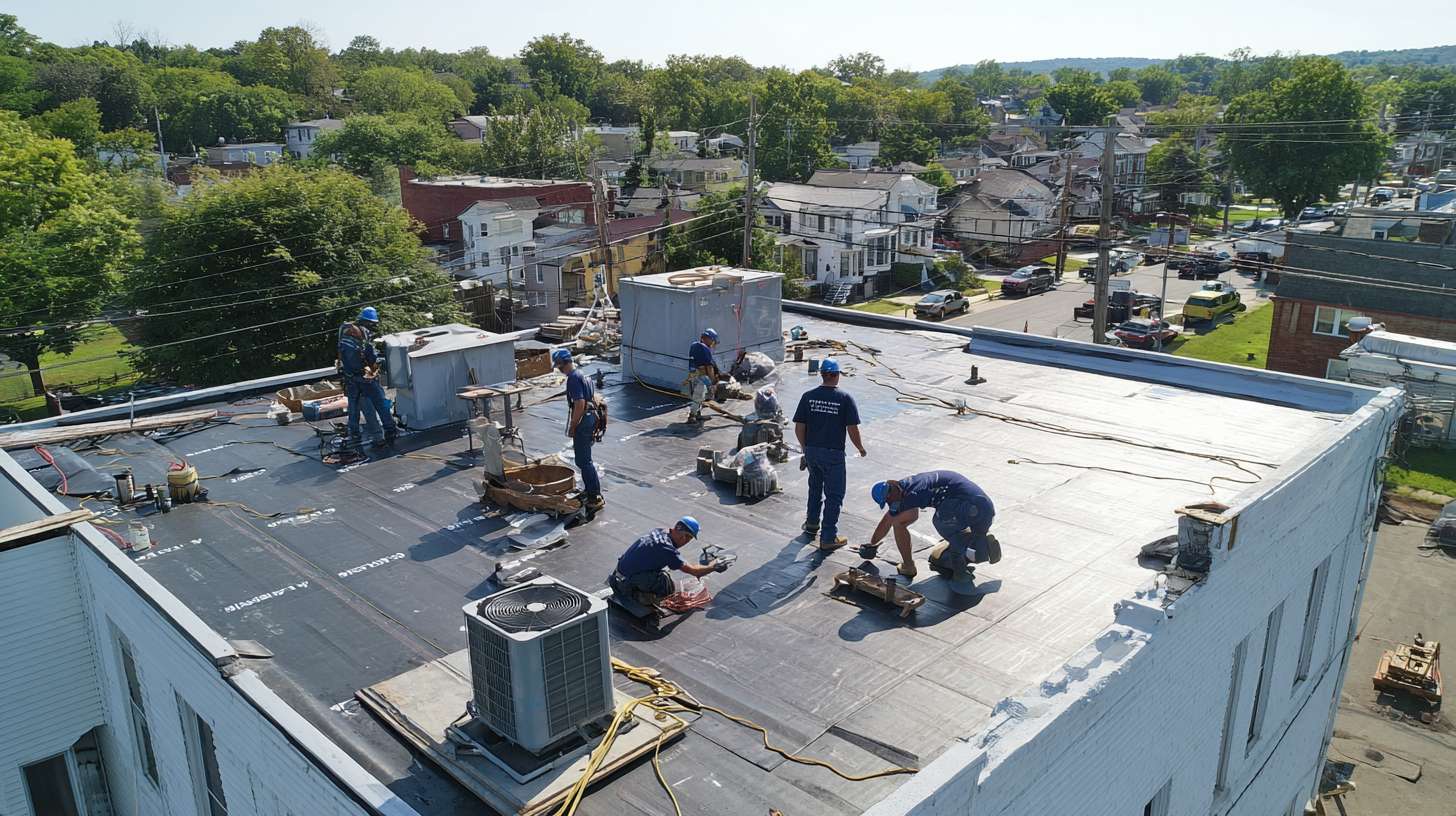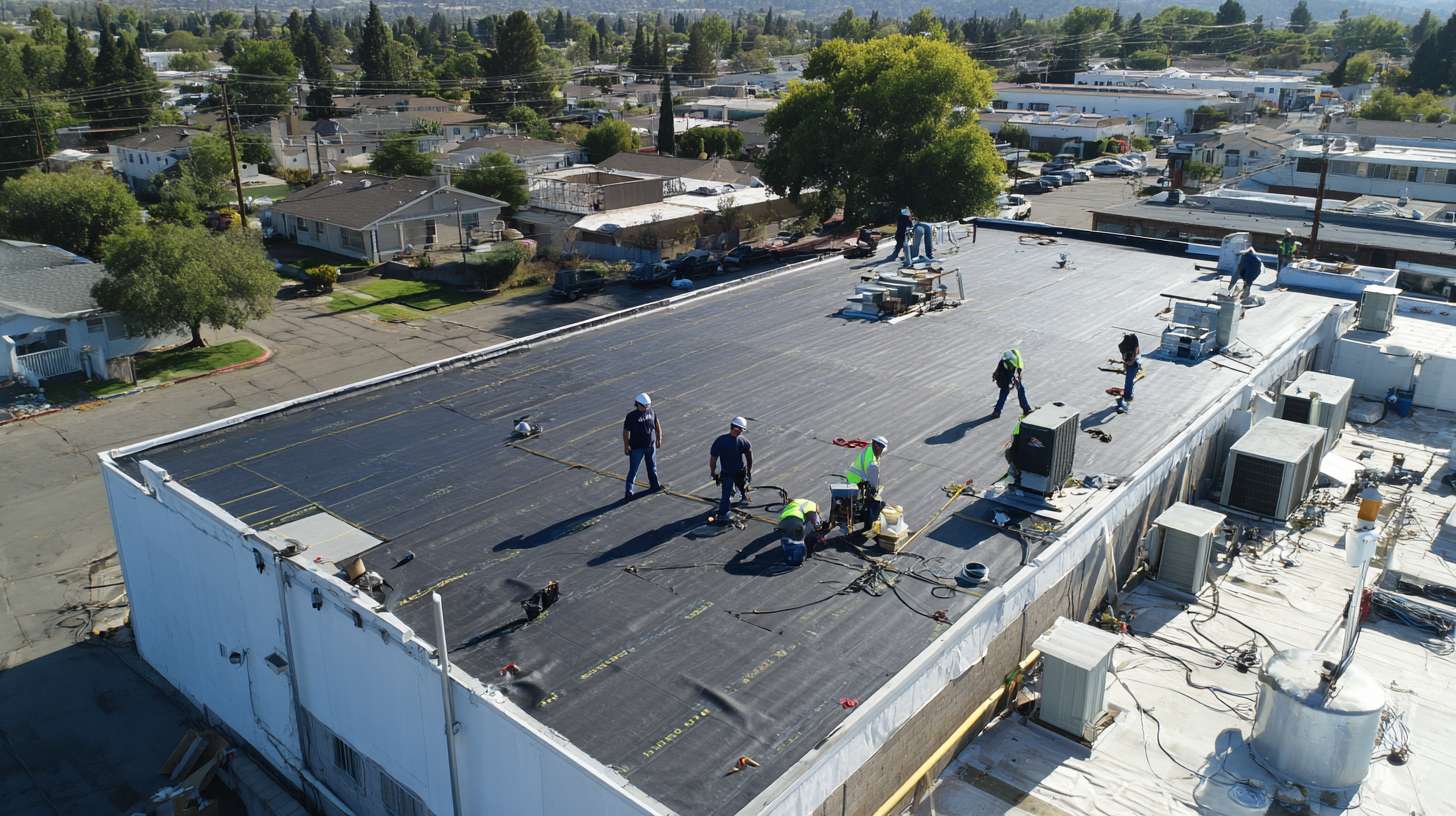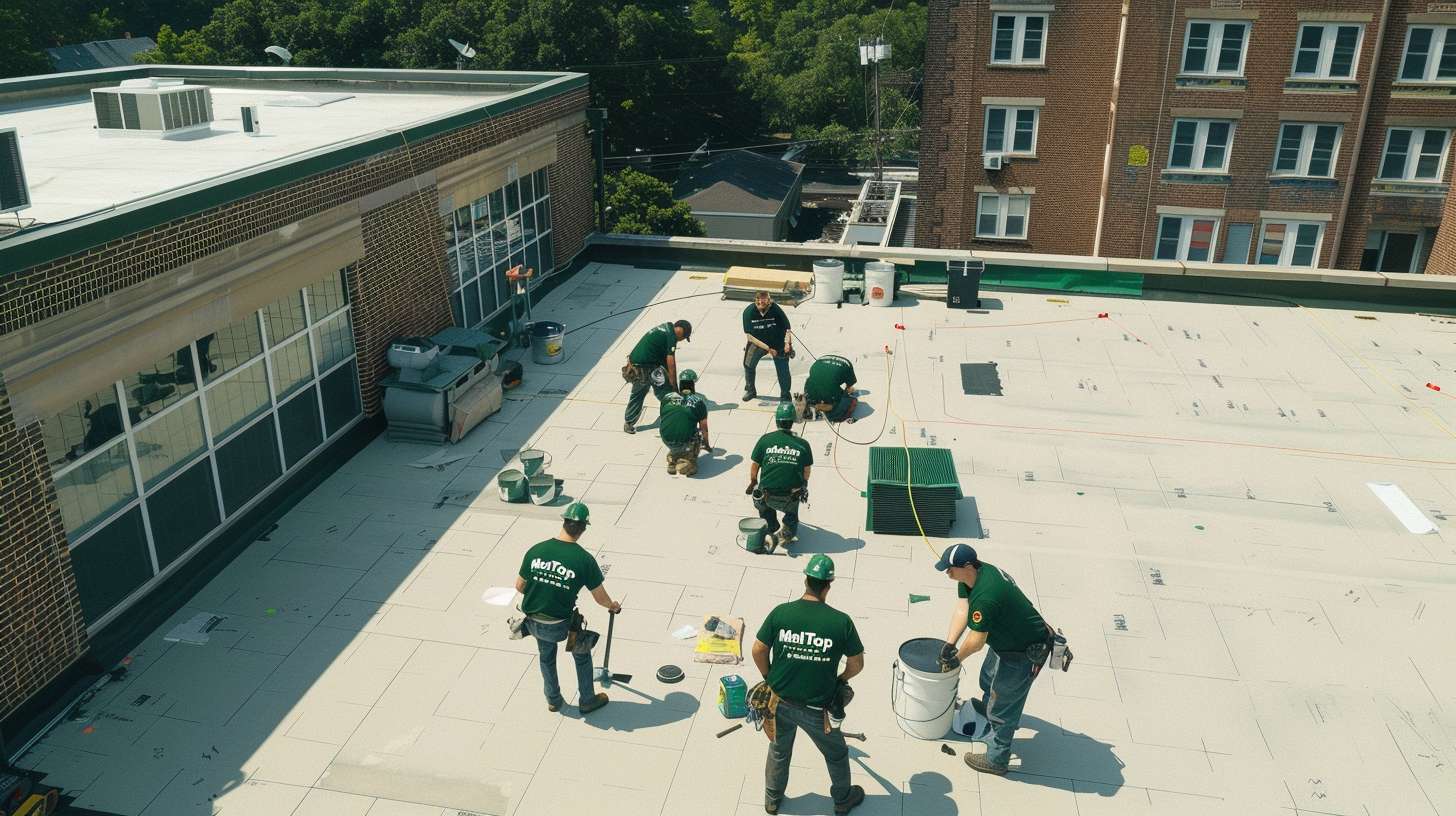
Professional Installing Step Flashing on Flat Roofs in Nassau County
Here’s something most people don’t realize until it’s too late: when a flat roof suddenly leaks where it meets a wall or transitions to a pitched section-and the membrane itself looks perfect-the culprit is almost always step flashing that was never installed correctly, or wasn’t installed at all. After 24 years tying flat roofs into vertical surfaces across Nassau County, I can tell you that more water enters buildings at these transitions than anywhere else on the roof. The membrane in the middle of your flat roof might be flawless, but if the step flashing installation on flat roof meets wall or roof-to-roof connections isn’t treated as a carefully layered system, you’re going to have mystery leaks that no amount of sealant will fix.
This guide walks through exactly how step flashing should be installed where flat roofs meet walls, chimneys, and adjoining sloped roofs-the technical details that separate a watertight joint from a recurring problem, explained so you can understand what’s happening even if you’re not swinging the hammer yourself.
Why Flat Roof Step Flashing Is Different-And Why It Fails
When most people hear “step flashing,” they picture what roofers use on a shingled slope where it meets a sidewall-individual L-shaped pieces that step up with each row of shingles. That system works because gravity and overlapping shingles create a water-shedding plane. But step flashing installation on flat roof transitions operates differently. You’re not shedding water down a slope; you’re managing water that pools, creeps sideways during wind-driven rain, and sits against vertical surfaces during every storm that rolls in off the Atlantic.
On a project in Merrick last winter, I was called to diagnose water coming through an interior wall every time it rained hard from the northeast. The homeowner had already paid for two “flat roof repairs”-both times, contractors just smeared more tar where the roof met the brick sidewall. When I pulled back the edge, there was no step flashing at all. The modified bitumen membrane just ran up the wall about four inches and stopped, with aluminum coil stock nailed over it. Every nail was a leak point. Every seam was open. The wind pushed water right behind that coil stock and down the wall cavity.
Step flashing on a flat roof has to accomplish three things simultaneously: integrate with the membrane below, create a stepped barrier that sheds water away from the wall, and tie into counterflashing or wall cladding above so no water can work its way behind the system. Miss any one of those, and you have a leak waiting to happen.
The Anatomy of a Proper Flat Roof to Wall Step Flash System
Let me break down what a correct installation actually looks like, layer by layer, because understanding the sequence is everything.
Bottom layer: membrane base. Your flat roof membrane-whether it’s TPO, EPDM, modified bitumen, or built-up-extends to the base of the wall and runs up the vertical surface at least 8 inches (12 inches is better in Nassau County where we get nor’easters that drive rain sideways). This base flashing is fully adhered or mechanically attached depending on your membrane system. It’s not optional trim; it’s structural.
Middle layer: step flashing metal. Individual step flashing pieces, typically 8-10 inches high and 10-14 inches long, are installed in a shingle pattern-each piece overlaps the one below by at least 3 inches, and each piece overlaps the membrane. These are bent from 16-ounce copper, aluminum .032 or thicker, or stainless steel if you’re near the water. The vertical leg goes up the wall; the horizontal leg lays flat over the membrane. Here’s the critical part most people miss: these pieces are installed as you build up the roof layers, not after. If you’re doing a modified bitumen roof with base and cap sheets, step flashing goes between those plies. If you’re doing TPO or EPDM, the membrane laps over the horizontal leg of each step piece.
Top layer: counterflashing or termination. The top edge of your step flashing tucks into a reglet (a kerf cut into mortar joints on brick), under siding, or gets covered by counterflashing that’s mechanically fastened into the wall and sealed. This is what keeps water from running down the wall and behind your beautiful step flashing work.
On a Long Beach row house where the flat roof met a sidewall dormer, the existing “flashing” was one continuous piece of aluminum bent in an L-shape and nailed every six inches up the wall-basically a water highway straight to the interior. We tore it out and installed copper step flashing in 18 individual pieces, each one overlapping 4 inches, each one integrated with the torch-down cap sheet. Five years later, that joint is still perfect, even after Sandy’s successors hammered that neighborhood.
Step Flashing Where Flat Roofs Meet Brick Walls
Brick presents the best and worst scenario for step flashing installation on flat roof to wall transitions. Best because you can cut a reglet into the mortar joint and create a mechanically perfect termination. Worst because if you don’t do it right, you’re inviting water into the brick itself, which then freeze-thaws its way into major masonry damage.
The process: After your membrane base flashing is up the wall and fully adhered, you install each copper or stainless step flashing piece so the top 1½-2 inches slides into a reglet cut into a mortar joint. That joint should be at least 8 inches above roof level-higher if code requires it or if snow accumulation is an issue. You pack the reglet with polyurethane or butyl sealant (never just caulk-it fails in two winters), then point over it with mortar that matches the existing. The step flashing piece below overlaps this one by 3-4 inches.
Each piece is mechanically fastened to the wall above the point where the piece below overlaps it-this is crucial. If you put a nail or screw where water runs, you’ve just created a leak. Fasteners go in the upper third of each piece, covered by the overlap from the piece above, and they’re always stainless steel or hot-dipped galvanized in coastal Nassau County.
| Wall Type | Step Flashing Material | Termination Method | Typical Overlap |
|---|---|---|---|
| Brick | 16 oz. copper or .032 aluminum | Reglet in mortar joint + sealant | 3-4 inches |
| Wood siding | .032 aluminum or copper | Behind siding, termination bar at top | 3-4 inches |
| Stucco/EIFS | Copper or coated steel | Termination bar + membrane strip | 4 inches minimum |
| Vinyl/fiber cement | Aluminum or copper | Behind cladding, sealed at top | 3-4 inches |
Step Flashing Under Siding (Wood, Vinyl, Fiber Cement)
When your flat roof meets a wall that’s clad in siding, the step flashing has to go behind the siding, not just under a piece of trim nailed over it. This means you’re often removing a course or two of siding to get proper integration-something contractors who aren’t detail-focused will skip because it adds time.
I worked on a Rockville Centre cape where the second-floor addition had a flat roof abutting the original house’s vinyl siding. The previous roofer had just run the EPDM up the wall and screwed aluminum trim over it-predictably, water was running behind the siding every rain. We removed the bottom three courses of vinyl, installed copper step flashing that slid up behind the siding and overlapped the EPDM, then reinstalled the siding over the vertical leg of the flashing. At the top, we used a termination bar through-fastened into the sheathing (hit studs where possible) and sealed the top edge with a peel-and-stick membrane strip before the siding went back. No exposed fasteners in the water path. No reliance on caulk. Just proper lapping and gravity.
The rule with siding: the horizontal leg of each step flashing piece must integrate with your membrane system, and the vertical leg must extend up behind the siding far enough that the siding overlaps it by at least 2 inches. Top termination is a metal bar, not caulk. Caulk is a maintenance item; metal lapped correctly is a permanent solution.
Where Flat Roofs Meet Sloped Roofs or Shingled Sections
This is where step flashing installation on flat roof systems gets really interesting, because you’re marrying two completely different roofing assemblies. The flat section is a membrane system; the sloped section is a shingle or tile system. The transition between them has to work with both.
Picture a typical Nassau County colonial with a first-floor flat roof over a family room addition, tying into the second-story shingled wall. Here’s how it should go: Your membrane runs up and onto the sloped roof deck-usually 12-18 inches-and is fully adhered. Over that, you install step flashing just like you would on any shingled sidewall: individual L-shaped pieces that step up with each course of shingles. Each piece overlaps the one below by 3 inches minimum, and each piece goes over the flat roof membrane on the horizontal leg and under the shingles on the vertical leg.
The tricky part: at the very bottom of this transition, where the flat roof meets the first course of shingles on the slope, you need a kickout flashing (or diverter) to push water out onto the flat roof membrane, not into the joint. I’ve seen more leaks from missing kickout flashings at this exact spot than almost anywhere else. Water runs down the shingles, hits the flat roof transition, and without a kickout, it just pours into the wall cavity.
On a Great Neck project where a flat garage roof met the main house’s gable end, we fabricated a custom kickout from 20-ounce copper that extended 8 inches out onto the membrane and 6 inches up under the shingles. It’s still the first place I point inspectors or homeowners when they ask what “doing it right” looks like.
Inside and Outside Corners: Where Step Flashing Gets Complex
Flat walls are easy. Corners-inside and outside-are where experience shows. An outside corner, like where two walls meet at a building edge, requires a folded corner piece that ties the two runs of step flashing together. You can’t just run step flashing up to the corner from each side and hope-water will find that seam. The corner piece is fabricated with a folded edge (or soldered if you’re using copper) and overlaps the last step flashing piece on each adjoining wall by at least 4 inches.
Inside corners-like where a dormer meets a flat roof deck-are even more critical because they’re natural collection points for water and debris. I always install a two-piece system: a base pan that sits in the valley of the corner, extending at least 12 inches in each direction, fully integrated with the membrane, and then step flashing that overlaps that pan on both walls. The pan is either soldered copper or a prefabricated stainless piece if the budget’s tight. Anything less, and you’re asking for problems when leaves and ice dam up in that corner.
Metal Choice and Why It Matters in Nassau County
Not all step flashing metal is created equal, and in Nassau County-with salt air from the ocean, freeze-thaw cycles, and occasional hurricane-force winds-cheap material fails fast.
Copper (16-ounce minimum): The gold standard. It costs more up front-about $340-$480 per 100 linear feet installed compared to $180-$260 for aluminum-but it lasts 50+ years and patinas beautifully. For historic homes in Garden City or Sea Cliff, copper isn’t just functional; it’s expected.
Aluminum (.032 or thicker): The workhorse. Mill finish or painted. It’s affordable, doesn’t corrode in salt air like steel, and bends easily on site. For most residential flat roof to wall transitions, .032 aluminum is my default recommendation. It’s strong enough not to buckle, light enough not to stress attachments, and widely available.
Stainless steel: For high-abuse locations-commercial flat roofs, buildings right on the water in Long Beach or Atlantic Beach-stainless is worth it. 24-gauge 304 stainless costs about 30% more than aluminum but handles impact and corrosion better than anything else.
I won’t use galvanized steel near the coast. It looks fine for three years, then the zinc coating fails, rust starts, and you’re back to square one. Not worth it.
Integration with Membrane Systems: TPO, EPDM, Modified Bitumen
The step flashing installation on flat roof projects varies slightly depending on your membrane type, because each bonds differently.
TPO and PVC: These are heat-welded systems. Your membrane base flashing goes up the wall first, heat-welded in place. Step flashing pieces are positioned, and then a strip of matching membrane is heat-welded over the horizontal leg of each step piece. You’re essentially sandwiching the metal between two layers of membrane-base below, strip above-all welded together. It’s bombproof if done correctly.
EPDM: Fully adhered or mechanically attached, EPDM uses bonding adhesive or tape. The step flashing horizontal leg gets primed, the EPDM membrane laps over it by 3-4 inches, and you roll it down with a seam roller. At the vertical wall, you’re using EPDM lap sealant at every overlap. Less forgiving than welded systems, but when done by someone who knows EPDM (and uses actual EPDM-compatible primers and tapes), it holds.
Modified bitumen: This is torch-applied or cold-applied. The base sheet goes up the wall; step flashing pieces are positioned; the cap sheet is torched over the horizontal leg of the step flashing. You’re heating the asphalt until it flows around and bonds to the metal. Over-torching melts the metal coating or burns the membrane; under-torching leaves gaps. It takes experience to get the heat just right, which is why I see so many bad torch-down step flashing jobs-crews rushing or undertrained.
Common Mistakes I See on Nassau County Flat Roofs
After two decades of diagnosing leaks, here are the recurring errors:
No step flashing at all, just sealant. Tar, caulk, or mastic smeared where the roof meets the wall. It might last six months. Then it cracks, pulls away, and water pours in. Sealant is a supplement to proper flashing, never a substitute.
Step flashing installed after the membrane is complete. This means the metal is sitting on top of the membrane instead of integrated with it. Water gets under the metal, sits on the membrane, and finds every seam and fastener.
Wrong overlap direction. Each piece has to overlap like shingles-the piece above covers the piece below. I’ve seen entire runs installed upside down, creating perfect scoops to catch and hold water.
Exposed fasteners in the water path. Nails or screws going through the horizontal leg where water runs. Every single one will leak, usually within the first year.
No counterflashing or termination at the top. Step flashing that just ends in mid-air, or tucked under a piece of trim that’s caulked. Water runs down the wall, behind the trim, and into the step flashing from above-backwards through a system designed to shed water down, not resist it coming from the top.
What It Costs and How Long It Takes
In Nassau County, professional step flashing installation on flat roof to wall transitions typically runs $32-$58 per linear foot, depending on wall height, access, metal type, and whether siding needs to be removed and reinstalled. A typical townhouse sidewall-say 20 feet long-costs $640-$1,160 in materials and labor for aluminum step flashing integrated with a TPO or modified bitumen system. Copper adds $380-$680 to that same run.
A full perimeter job on a 900-square-foot flat roof deck with walls on three sides (about 65 linear feet of step flashing) generally falls in the $2,080-$3,770 range for aluminum, $3,200-$5,100 for copper, assuming standard 8-12 inch wall height and no major siding removal.
Time-wise, doing it right isn’t fast. A 20-foot run with proper membrane integration, overlapping pieces, and top termination takes a skilled crew about 4-6 hours. Corners, siding removal, or brick reglet cutting add time. Rushing it is how you get the callbacks.
Why Building Codes Require What They Require
New York State building code and Long Island-specific amendments require step flashing to extend at least 4 inches up the wall (8 inches in most practical applications), overlap a minimum of 2 inches (though 3-4 is standard practice), and be made of corrosion-resistant metal. These aren’t arbitrary numbers. The 8-inch height accounts for snow accumulation and splash-back during heavy rain-water bouncing off a flat roof surface can reach 6 inches up a wall. The overlap requirements come from wind-driven rain testing: anything less than 3 inches of overlap allows capillary action and wind pressure to push water between pieces.
The corrosion requirements exist because Nassau County is coastal. Salt air corrodes cheap metal fast. What looks fine in Kansas fails here in three winters. Inspectors who know flat roofs will check metal gauge, overlap, and fastener type because those are the details that separate a 30-year system from a 5-year problem.
When to Call a Specialist vs. Trying DIY
I’ll be straight: step flashing installation on flat roof systems is not a YouTube-and-a-weekend project unless you have metal fabrication experience and you understand membrane systems. The margin for error is thin. One piece installed backwards, one missed overlap, one fastener in the wrong spot, and you’ve got a leak that might not show up until water has already damaged sheathing and framing.
If you’re a homeowner with a small flat roof repair and a simple wall transition, you might handle base flashing and a termination bar. But the minute you’re talking about corners, siding removal, or integration with TPO or torch-down systems, you’re into territory where experience matters. A qualified flat roof contractor in Nassau County will have the tools to cut reglets, bend custom corners, heat-weld or torch membrane correctly, and know which metal to use for your specific exposure.
At Platinum Flat Roofing, we treat every wall and roof-to-roof transition as a potential weak point until the step flashing proves otherwise. That means full membrane integration, properly lapped metal, mechanical terminations at the top, and no exposed fasteners. We’ve been doing this across Nassau County since the late ’90s, and the reason we get called back is not to fix leaks-it’s to do the next building.
If your flat roof is leaking where it meets a wall, or you’re planning new construction or a roof replacement and want the transitions done right from the start, the details in this guide are what separate a watertight job from an ongoing problem. Step flashing isn’t glamorous, and most people never see it once it’s installed. But it’s the difference between a flat roof that lasts decades and one that leaks every winter.